
When a Product “Works,” but Trust Is Already Gone
When people use a product, they rarely think in terms of “there’s a bug,” “there’s a logic issue,” or “something broke on the back end or front end.”
For users, it’s much simpler: the product either behaves the way they expect it to — or it doesn’t.
If an action fails, a status doesn’t update, funds don’t appear in the balance, a notification arrives too late, or the interface behaves in a strange way, users don’t stop to figure out where exactly the issue happened.
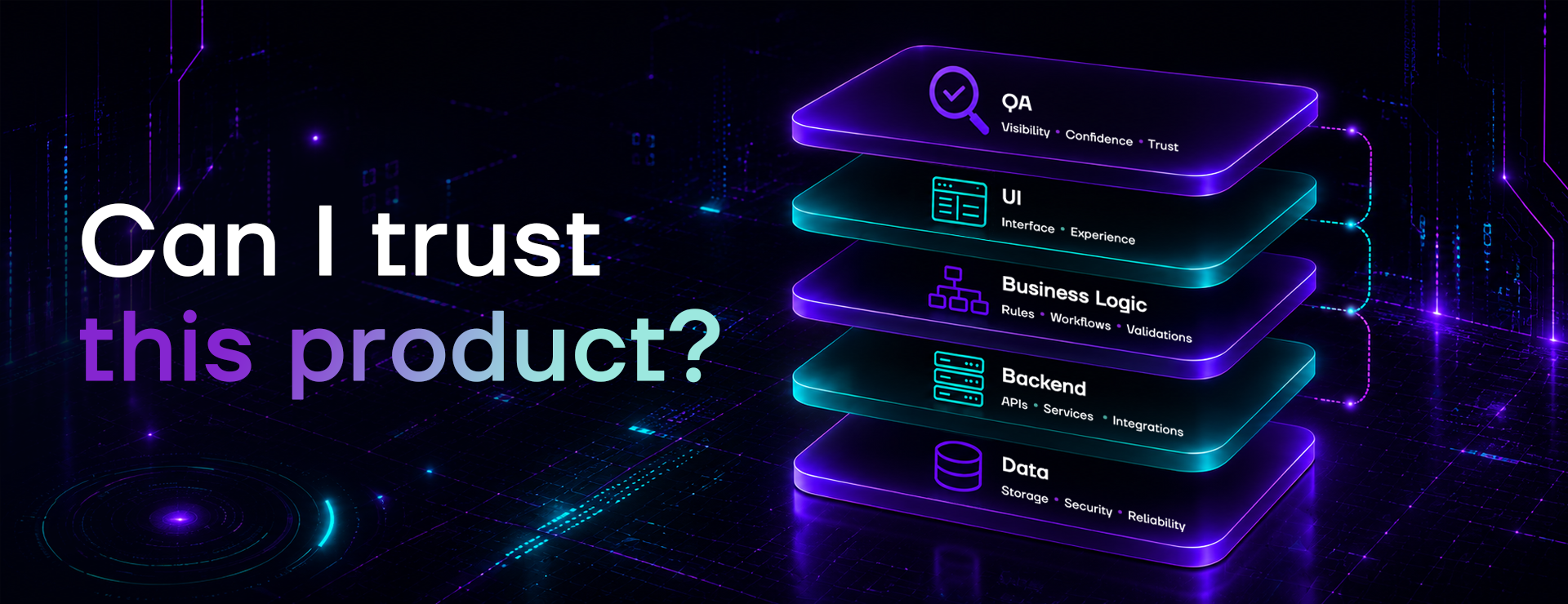
They start wondering something much simpler: Can I trust this product?
And to me, that’s where the real role of QA begins. QA isn’t just about finding bugs before a release. It’s about helping the team see where a product can lose user trust. Sometimes that’s an obvious defect. Sometimes it’s a less visible risk. Sometimes it’s a flow that technically “works,” but still feels confusing, unreliable, or unpredictable from the user’s perspective.
Trust in a product doesn’t appear in one specific place. And it’s not something you can “add” right before release. 🙂
Trust as the Result of a System of Decisions
Trust is built gradually:
- in product decisions;
- in engineering implementation;
- in team communication;
- in how carefully we think through details and the consequences of change.
All of this eventually turns into one simple feeling for the user: Can this product be trusted or not?
You can build functionality that fully matches the requirements. You can test the main flows and confirm that everything opens correctly, buttons work, and data is saved. Formally, everything may look fine, but good QA questions usually go further:
- What happens if the user doesn’t follow the ideal flow?
- What if the data arrives with a delay?
- What if the user goes back to the previous step?
- What if the action is completed, but the status hasn’t updated yet?
- What if the issue affects a group of users rather than just one?
- What if the user already has legacy data in their account?
These questions are not always about bugs. More often, they’re about risks.
QA as a Way to Expand the Team’s Perspective
Over time, I started realizing that the value of QA isn’t simply in saying, “There’s an issue here.” What matters more is helping the team see:
- where weak spots might appear;
- where transparency can be lost;
- where users may draw the wrong conclusion;
- where everything is technically correct, but still doesn’t feel trustworthy;
- where we may need a fallback plan if something goes wrong.
At this point, QA stops being the final checkpoint and becomes a way to expand the team’s perspective.
You can especially feel this during releases. A release is not just the moment when changes go to production.It’s the moment when the team takes responsibility for keeping the user experience stable. And QA’s role here goes far beyond final verification.
QA helps the team understand the bigger picture:
- what exactly changed;
- which areas were affected;
- which scenarios carry the highest risk;
- where additional validation is needed;
- and where a reasonable compromise makes more sense.
QA and Decision-Making
As your approach to QA matures, you stop looking at tasks in isolation.
You start seeing the system as a whole: the product, the user, business logic, technical limitations, team decisions, and the consequences of change. A good QA engineer isn’t someone standing “at the end of the pipeline” just looking for defects.
They’re part of the decision-making process. Sometimes through testing. Sometimes through asking the right questions. Sometimes through identifying and discussing risks. Finding a bug is only part of the job.
What matters just as much is understanding:
- why it happened;
- what its real impact is;
- how it affects users;
- what else could break around it;
- whether the release should actually be blocked;
- or whether the situation can be managed in a controlled way.
At the same time, QA isn’t about “knowing better” than everyone else or blocking releases by default. And it’s definitely not about blocking for the sake of blocking, it’s about visibility.
About making sure the team clearly understands:
- what has been verified;
- what hasn’t;
- where the risks are;
- how serious those risks are;
- and what options exist for handling them.
At that point, decisions stop being individual and become shared team decisions.
Sometimes the answer is: release, because the risk is low; or release, but with additional monitoring; or even postpone, because the cost of failure is too high. What matters most is not simply saying “yes” or “no.” The matters is how consciously the team makes that decision.
QA as Part of the Trust System
In that sense, QA directly influences trust in the product. Not because QA alone owns quality. Quality is the responsibility of the entire team.
But QA often helps make that quality visible — helping teams notice the things that are easy to lose somewhere between requirements, deadlines, and technical implementation.
And in that sense, QA becomes part of the system that shapes:
- product stability;
- predictability;
- product reputation;
- and ultimately, trust.
And if, after a release, users simply move through their flow without thinking about how many decisions were made behind the scenes — that’s usually a sign the system worked.
Final Thoughts
For me, QA is about participating in the creation of a system where products behave predictably, teams make informed decisions, and users can trust what they see.
It’s about creating an experience where users don’t have to second-guess the product — and where teams make decisions with a clear understanding of risks, quality, and consequences.
_________________________